Showing posts with label Beach. Show all posts

Thursday, February 7, 2013

Galveston Birds in Winter

We've had some really pleasant weather this winter along the gulf coast of Texas.  Its nice to be able to go to the beach for a walk while there are few tourist and not many crowds or traffic. There are many resident birds here on Galveston Island and also quite a few winter visitors.  

Roseate Spoonbills - Platalea ajaja,  in Galveston Island State Park

Mottled Ducks - Anas fulvigula maculosa, can be see year round on Galveston Island. Many other waterfowl winter here such as: Mallard, Pintail, Northern Shovelers, Blue & Green-winged Teal, Lesser Scaup, Ruddy Ducks, and Red-breasted Merganser.

Neotropic Cormorants - Phalacrocorax brasilianus.
Similar to Double-crested Cormorants but have a longer tail and smaller size. They also have that V-shaped border on their chin patch clearly seen on the bird in the middle of the picture.   

Double-crested Cormorant - Phalacrocorax auritus
You can see its short tail but also in real life it looks larger and huskier than the Neotropic. 

Snowy Egret - Egretta thula

Forster's Tern - Sterna forsteri


Royal Tern - Thalasseus maximus
A unfortunate sight...  And sadly there were a few other dead birds along the beach: Laughing Gulls, Ring-billed Gull, & Brown Pelican; that I could identify. With all the runoff from Houston and surrounding cities there was an abundance of visible pollution as well as lots of fishing line and other gear discarded on the beach.  
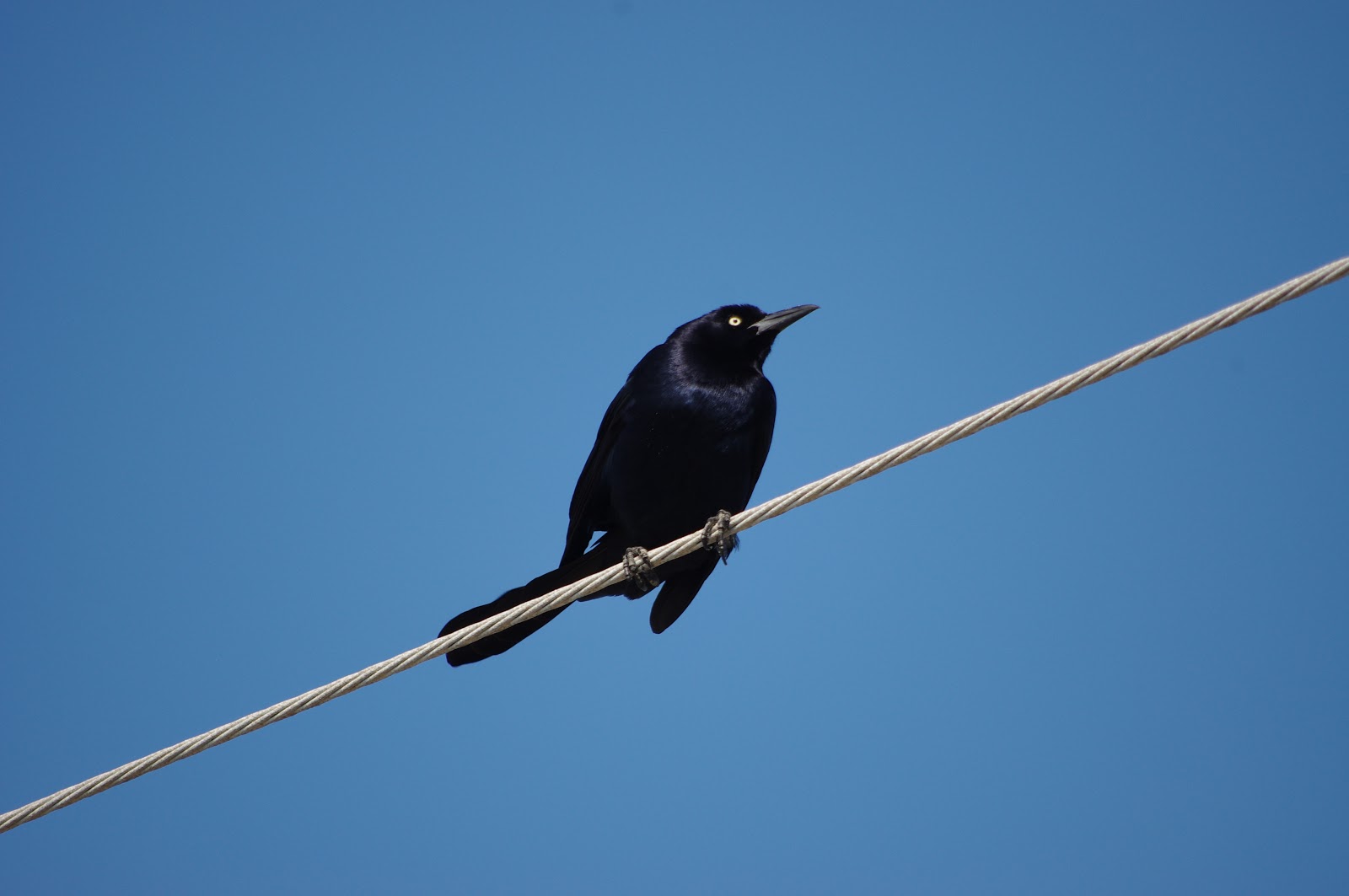
Great-tailed Grackle - Quiscalus mexicanus

Great Blue Heron - Ardea herodias 

Ruddy Turnstone - Arenaria interpres
One of the few shorebirds I have seen lately.  On previous trips this same spot had many other species present including the endangered Piping Plover.

Savannah Sparrow - Passerculus sandwichensis
Quite a few here birds in the grassy areas along the shore.  These are winter visitors.  

American Pipit - Anthus rubescens
Another winter visitor.

Glaucous Gull - Larus hyperboreus
A rare bird from the north.  Common around Alaska.  This gull stuck out like a sore thumb with pale plumage and its huge size among the already large Herring Gulls.  It's interesting that it found its was all the way down here. 

Tuesday, February 5, 2013

Razorbills in Florida

Before my Christmas trip to Florida I read a very interesting news article about large numbers of Razorbills around the Florida coast.  This was extremely unusual as Razorbill usually inhabit very cold northern coastal areas. So after reading the article I thought I'd check out the area where the birds were seen which is a beach I usually go to when Im in Florida.

This beach/park is on the northern tip of Anna Maria Island, in Bradenton, Florida.  This side is facing Tampa Bay.
The Razorbills were easily spotted swimming in the clear blue water. They were fairly close to shore.  I didn't use any zoom for this picture. 

The mostly looked like they were resting.

These two were looking for fish but I did not see them catch any.

Unfortunately a dead one was found washed up. Only the wings and skeleton remained.  Perhaps it was exhausted from the long flight or couldn't find food.  A sad sight.

A last view of the Razorbills before we left.  I always thought I'd have to travel way up north to get a glimpse of them!

Here is a link to the article that I read from eBird.  It is very interesting and there is a lots of information about sightings (some in the hundred!), other unusual northern species seen,  and why this whole phenomenon is taking place:  Razorbills invade Florida.


Thursday, September 6, 2012

Snorkeling at Playa Uvas Beach Club - Cozumel, MX

Last week I took a cruise that stopped on Cozumel, Mexico.  I had been to Cozumel two other times but this time we were dropped off in a different location than before.  We used to snorkel at a restaurant/bar just a few blocks from the cruise port but we had no idea where it was so after some advice from a local we took a quick taxi drive to Playa Uvas Beach Club.  The beach club was reasonably priced and offered rental snorkel gear like many other places along the beach.  Since we were short on time I got into the water and started snorkeling right away.  

The water in Cozumel is beautiful.  Very clear and has a good amount of reef organisms.  The sun was shinning brightly but a storm was quickly rolling in.  

I love looking for Echinoderms whenever I'm at the beach.  I found a bunch of beautiful brittlestars.  This one is Ophiothrix angulata. 

A school of Yellow Grunt - Haemulon flavolineatum

An interesting Octocoral

Vase Sponge 

Caribbean Sea Anemone - Condylactis gigantea

Lettuce Coral - Agaricia tenuifolia


Lots of very friendly Sergeant Majors - Abudeduf saxatilis, Im sure they are used to being fed when groups of snorkelers come out. 

A curious but fast Rock Beauty -Holacanthus tricolor

Peacock Flounder - Bothus lunatus, seemed to change color a little to match the substrate. 
At this moment when it started to swim it had darkened. 


Long-spinned Urchin - Diadema antillarum 

French Angelfish - Pomacanthus paru, both are transitioning from juvenile to adult coloration.  

The wind picked up, the temperature dropped, and the rain started pouring really hard so we were asked to come up and we went back to the cruise ship.

This short time was definitely the highlight of the whole trip for me! 
I cant wait to go back to visit again. 

All pictures taken with my Olympus Tough TG-610.

Sunday, August 5, 2012

Creatures in the Sargassum - Padre Is. Natl. Seashore

Since I was little I have always searched through the seaweed in search of sea creatures.  There was always an abundance of interesting things to find from shrimp to juvenile fish and occasionally a bright yellow seahorse.  Seaweed or Macro-algae differs from place to place as well as the organisms that inhabit them.  

Here on the Texas coast of the Gulf of Mexico we have lots of sargassum seaweed.  
Sargassum is found throughout the tropical seas and host many specialized groups of plants and animals  found no where else.  These organism have evolved with the sargassum and many mimic the look of sargassum for camouflage. 

Padre Island National Seashore - Malaquite Beach 
This is one of my favorite places in Texas!  Whenever I show other Texans pictures like this they think it is somewhere exotic but it is actually right of the coast of Corpus Christi. 

Sargassum sp. floating along.  There are many rafts of these floating communities drifting around the Gulf of Mexico.  It looks like just seaweed but you would be amazed by what's actually inside. 


Sargassumfish - Histrio histrio,  is highly camouflaged in the Sargassum.
This unusual predatory fish is pretty easy to find. 


Shrimp - many different species of shrimp are commonly found in Sargassum. 

Hermit Crab - usually not found in Sargassum but this one must have hitched a ride at some point. 

Pygmy Filefish - Stephanolepis setifer
This was one of the most common fish found in the Sargassum today.  

Pygmy Filefish - Stephanolepis setifer
This one is a little bigger...

Juvenile Scrawled Filefish - Aluterus scriptus
I have never seen this fish in the Sargassum before.  I have read that it usually inhabits reef areas. 


Juvenile Chub - Kyphosus sp. 


Sergeant Major - Abudefduf saxatilis
These are a common sight in the Sargassum and throughout the Gulf.

unknown fish... any guesses? 

'
Juvenile Jack (?)

Pipefish - 

Pipefish - 

Saturday, October 22, 2011

Kayaking - Miguel Bay, FL

Florida has so many wonderful outdoor activities and while on vacation here I have been doing as many as possible! Yesterday, I had a really nice kayaking trip with my Dad to Miguel Bay - a small bay at the southern portion of Tampa Bay. It was cool, the water was calm and clear, and it was nice and sunny. We saw an abundance of wildlife in the beautiful habitat of mangrove swamps and seagrass beds.

Here I am going through small islands of mangroves. Mangroves provide very important habitat for countless marine organisms such as fish, birds, and in some places crocodiles.

The Red Mangrove - Rhizophora mangle, is identified by its long prop roots and its propagules that resembles a long seed pot.

The beginning of a propagule - soon it will look like a long thick green bean which detaches and floats in the sea until it finds a suitable place to attach, grow roots, and become a new tree.

The low tide exposes oyster beds.

Barnacles grow on dead mangrove branches.

Turtle Grass - Thalassia testudinum

Shoal Grass - Halodule wrightii (bottom, left) and Manatee Grass - Syringodium filiforme (top, right).

Horseshoe Crab - Limulus polyphemus

Hermit Crab shell changing station.

Sea Stars - Echinaster graminicola, most common sea star around tampa bay.

Sea Star - Echinaster graminicola.  This sea star can be distinguished from its sibling species that also lives in the area Echinaster spinulosus.  E. spinulosus has blue/gray coloration between the spines where E.graminicola is reddish brown. It is slightly more spiny than E. graminicola, and I've also noticed that E. spinulosus tube feet are yellow, where E. graminicola are orange. E. graminicola is usually found in shallower water as well.

Variegated Sea Urchin - Lytechinus variegatus

Tulip Snail - Fasciolaria tulipa

Lightning Whelk - Busycon contrarium, a young one.

This is hard to see but its a very large Florida Horse Conch - Pleuroploca gigantea, eating a Lightning Whelk - Busycon contrarium.

Comorants - Phalacrocorax, resting in the mangrove trees.

White Ibis - Eudocimus albus

Tricolored Heron - Egretta tricolor

Great Blue Heron - Ardea herodias

Sandwich Tern, Laughing Gull, American Oystercatcher, and in the back a Reddish Egret. (left to right)

Woodstork - Mycteria americana

What a wonderful day it was! I cant wait to go back and explore some more!