Sunday, July 17, 2011

Western Ribbon Snake

Yesterday night I went to water my tropical carnivorous plants that are growing on a garden shelf in my backyard. On the second shelf I found a Western Ribbon Snake. It must have climbed up looking for the Rio Grande Chirping Frogs (see previous post). The frogs chirp constantly and the snake was right next to a pot that had a Chirping Frog in it.

Here is the Western Ribbon Snake - Thamnophis sauritus nitae. A very appropriate name for this snake. The Ribbon Snake is non-venomous and eats insects, slugs, frogs, and small fish.

It was very docile and never tried to bite even when I touched it. It is surprisingly fast at slithering away too.

This was actually the third one I've seen in my yard this year. The last time I saw one it was by my front yard street light being eaten by a Yellow-crowned Night Heron, which swallowed it whole.

Thursday, July 14, 2011

Sarrcenia alata and the Drought

As you know this year and for the past few years much of the south has been in a drought. Many parts of the south are in an extreme or exceptional drought condition. These areas are home to many many unique plants and animals many of which are endemic to the south eastern United States. One group of these unique species is the Pitcher Plants of the genus Sarracenia. The pitcher plants are a remarkable carnivorous plant which lives in poor sandy acidic soils of the south east and have extraordinary colorful pitcher shaped leaves. All but one specie in the genus live on the coastal plane from Virginia south to Florida and west to east Texas. All of these species have become extremely rare and some critically endangered.
US Drought map for today showing much of the south covered in extreme and exceptional drought. Much of this area is Sarracenia habitat.

I wondered what effect the drought had on the local Sarracenia alata population in Big Thicket National Preserve. Usually the pitcher plants there are always healthy and colorful with pitchers lasting until winter. So we went to the Pticher Plant Trail to pay them a visit.

The effects of the drought were very clear. The Sarracenia alata pitchers were all dry and dead only being green a few inches above the rhizome. Many of the seed pods that were maturing seemed to be dead and dry before the seeds were ready. It was sad...

Here is pitcher that still has a little life surrounded with dead pitchers. There was also a lot of healthy Prairie Blazingstar - Liatris pycnostachya, a late summer/fall blooming wildflower that are more tolerant of dry soil.

I found a few whole pitchers. These were all small, less than 8 inches tall.

There was no sight of any other carnivorous plants that we usually see here such as: Drosera, Pinguicula, and Utricularia. The patches of Sphagnum moss were completely brown and dry. The sandy soil was also bone dry.

Dried up Sphagnum moss

After the pitcher plant trail we went to the Sundew Trail to see how the smaller population of Sarracenia alata was doing over there and hopefully photograph some Blazingstar - Liatris but the Sundew trail was worse than the Pitcher Plant trail.

These plants have endured droughts many times before this and it is part of the natural cycle but one can only wonder how long the drought can last and why is it so severe? Hopefully the rain will come soon and restore this area back to its former beauty.

Just to leave on a bright note: here is one of the few plants that were flowering.

Vernonia texana - Texas Ironweed


Wednesday, July 13, 2011

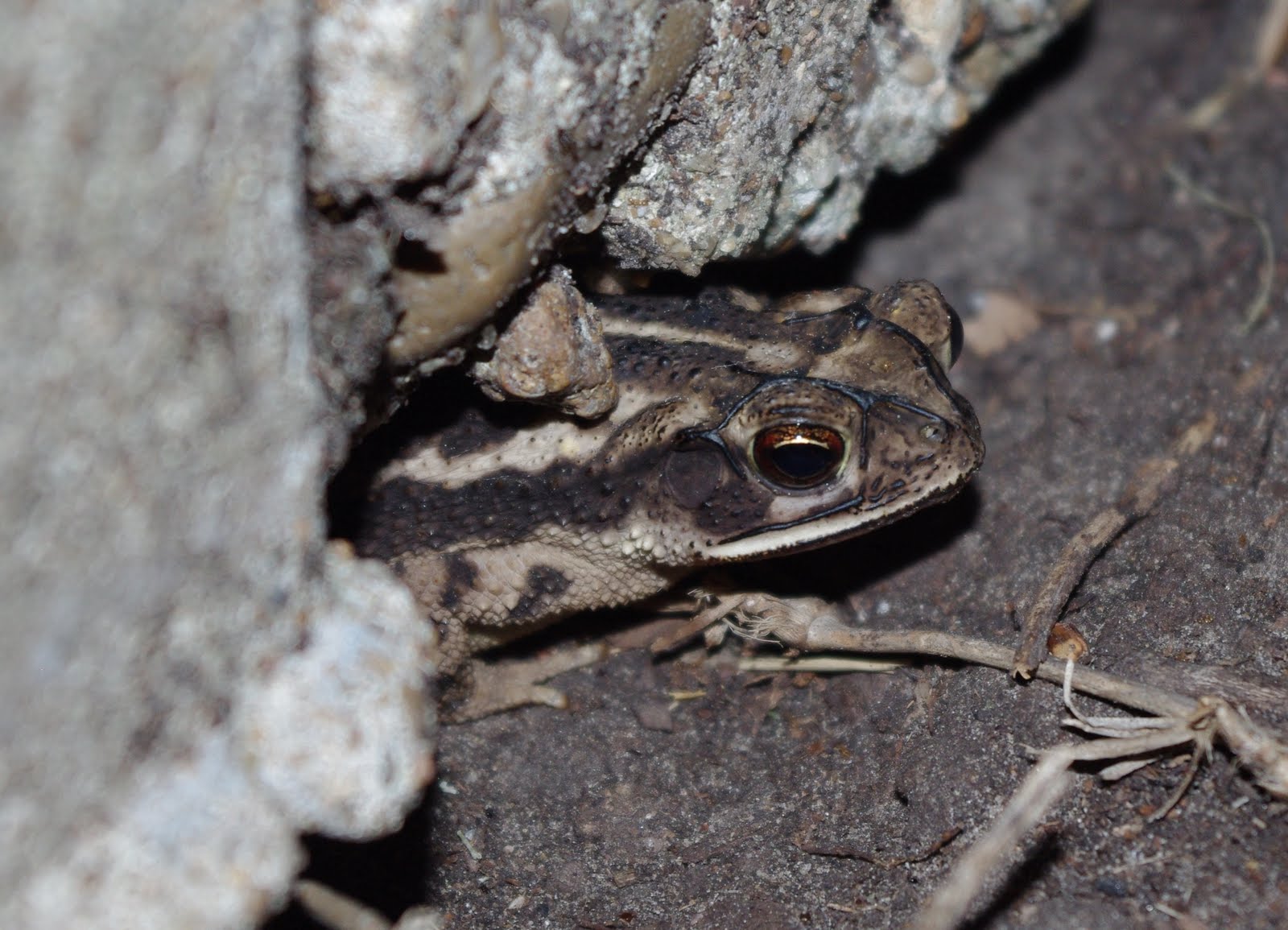
Gulf Coast Toad

Lately, when I have come home from the gym at night, I've noticed something next to my driveway. When I get close it hops back and goes under a buckle in the driveway caused by an Oak tree. Upon closer inspection I found it is a Gulf Coast Toad - Bufo nebulifer.

The taxonomy of the Gulf Coast Toad is a bit confusing. The scientific name of this species has been undergoing some changes. This toad seems to be the most abundant specie of toad in the Houston area. I have seen it all over the city in neighborhoods and apartment complexes. It is very easily found at night after a rain where it can be seen hoping around the streets, sidewalks, and lawns. It eats any small animal that will fit in its mouth.

Here is the toad sitting outside of its home. Garden centers sell toad homes which are like an upside-down pots with a hole on the side for them to enter but toads will use many things to make there homes. A lot of times I find toad homes at the base of a tree betweeen the groves that will form roots below the surface of the soil.


One of the keys to identifying the Gulf Coast Toad is the dark band that runs a long side of the animal. They also have a deep V ridge between the eyes. The size is about 4 inches from tip of mouth to the tail end.

At night time after a rain look out for these toad while driving through your neighborhood. Drive slowly because they usually just look like a stone or leaf until they hop-hop-hop. Also, be careful not to run them over. Toads are beneficial to humans because they eat tons of insects (including big disgusting cockroaches) and keep those insect populations down.

Friday, July 8, 2011

Dinner at Uni

A few days ago my friends and I went to the Woodlands, TX to have dinner at a place called Uni.

Uni, which is the Japanese name for sea urchin, is located in the Market Street center very close to the Woodlands Mall. It was my first time visiting the Market Street shopping area which is a clean, lively, and diverse center. The restaurant Uni is next to the Cinemark theater across the street from the Central Park area. The outside of Uni is decorated with black tiles which makes it stand out from the many country style shops. The inside of Uni is nicely designed and service was good. But more importantly is the food...

Everything we had was really good. The presentation of each dish was very nice, the ingredients were fresh, and all the rolls were made neatly. Here are a few things that we had:

Chirashi bowl - mixed sashimi which was fresh and sliced to the prefect portion.

Tiger Eye and Brendy - Specialty Rolls

Specialty Rolls - the cutest Caterpillar roll I have ever eaten!

Chipotle Salmon

We also had seaweed salad, gyoza, and miso soup, which were all very good. The miso soup was much more hearty than many other places I've tried - it had a lot of mushrooms, seaweed, tofu, and green onion.

ahh.. Whenever I make post about food I get hungry. Overall, I really liked this place and will definitely be back!


Thursday, July 7, 2011

Summer Wildflower Seeds

Hello! After the nice rain we got yesterday things are looking a little bit greener! My native plant garden has tons of blooms from Rudbeckia, Gaillardia, Tradescantia, Salvia, Vernonia, Malvaciscus, Helenium, and Helianthus. A lot of flowers are also starting to set seed. I spent some time this morning dead-heading some of the flowers and collecting seeds to store and share with friends. Here's what has seeds now:

Echinacea sanguinea - Sanguin Coneflower, this plant is doing very well in the intense heat and drought conditions. It is a must grow if you live in Houston or East Texas, to which it is native.

Helianthus annuus - Common Sunflower, The seeds that I planted last winter are now huge 12 feet tall plants with lots of blooms. I collected some seeds but will leave many for the birds to eat this fall and winter. Im sure the Goldfinches will love them when they return this winter.

Gaillardia pulchella - Indian Blanket, I think this plant never stops blooming... it continuously makes flower and lots of seeds. The seed heads are spiky so use gloves when collecting seeds.

Ratibida columnifera - Mexican Hat, the seeds are ripe and already falling off.

Rudbeckia maxima - Giant Coneflower, The seeds are almost ready.

Coreopsis lanceolata, Lanceleaf Tickseed - I collected lots of seeds from these plants today.

Here are some of the collected seeds. The top is Coreopsis lanceolata, right is Helianthus annuus, and bottom is Gaillardia pulchella. Im going to let them dry a little more before cleaning them and storing the seeds in paper envelopes.

Jadeite Cabbage

I got a package today...

It is a Jadeite or Green Glass Cabbage Dish. It is from the now retired Martha by Mail collection. I have started collecting MBM Jadeite things for my office because it goes really well with my charcoal furniture and beryl green walls. The jadeite kind of glows especially at night when the lighting is ambient.

Martha by Mail Jadeite Cabbage Dish


The bottom of the dish is unmarked but from the research I did I think it was made by L.E. Smith glass company for Martha by Mail.

The dish is covered and can be used for serving various things.


Wednesday, July 6, 2011

Lunch at Thai Cottage

For lunch Tink and I went to Thai Cottage restaurant on Westheimer Rd in Houston. It was excellent. I had the lunch special Pad Thai which came with a salad and spring roll. It was the best Pad Thai I've had in Houston so far. For the price ($6.25) the food quality was very good!

Photo taken with my iPhone.

My Pad Thai was very good. Not too wet or dry and lots of meat and veggies.