Showing posts with label Carnivorous Plants. Show all posts

Thursday, March 14, 2013

Pinguicula lutea blooming

My Pinguicula lutea is finally blooming! The first flower was somehow destroyed and now the second flower stalk that has been slowly growing has started to bloom.  I think it is still growing - during the day it opens and nights it droops and closes.  There is another flower bud that is also forming in the center of the rosette. I pollinated the flower after I photographed it this morning and in about four weeks they should be ripe. It also looks like this will be the last act of my P. lutea. They are a short lived perennial and usually bloom themselves to death.

Just like my P. planifolia I grow my P. lutea outside all year with sun during the morning and shade in the afternoon. They are grown with the tray method. I tried undrained pots previously but they succumb to rot easily. P. lutea can tolerate somewhat drier conditions in the wild than some other Pinguicula.

Pinguicula lutea flower "sleeping" at night.  This movement is called nyctinasty.

Pinguicula lutea blooming in the warm sun. 

A side view showing Pinguicula lutea's spur.  It looks like a bee could fit perfectly in there. 

It is really starting to feel like spring! 


Tuesday, March 5, 2013

Pinguicula planifolia blooming

Spring is in just a few weeks and here in Houston, TX we are seeing many signs of spring.  Many of my native wildflowers are blooming and other trees and shrubs are sprouting new leaves.  The carnivorous plants faired pretty well this winter (I did loose a few Sarracenia to rot) and all are starting to wake up.  Some of the Sarracenia have flower stalks growing and the SE Pinguicula have started to bloom.

My Pinguicula planifolia are the first to bloom!

Pinguicula planifolia - grown outdoors all year.  They receive full sun for half of the day and then shade for the rest of the day.  Of all the things I've tried here in Houston, TX, this seems to work the best. Our  afternoon temperatures are often over a hundred in the summer and the water evaporates before the day is done; especially if left in full sun throughout the day! 

P. planifolia - the rosettes of my plants are pretty small.  They might appreciate more water but I wanted to keep them on the dry side to keep them from rotting during winter.  Wild plants are often submerged for short periods of time. 

The flower stalk has an unusual shape.  Perhaps because of our drastic weather changes lately.  Almost 90 degrees in the day and 30s at night.

My P. lutea was also going to bloom too but some critter bit off its flower bud.  Thankfully its growing another one. 

Saturday, August 11, 2012

Growing Nepenthes in Houston, TX

Gardening in Houston, TX is very challenging to say the least.  The best/easiest plant to grow are natives.  Native plants are adapted to the wide variety of weather conditions Houston has.  Naturally growing non-native plants, such as Nepenthes, can be quite challenging.

During the spring, summer, and fall I keep my Nepenthes outside in the shade of a crepe myrtle tree and the wooden gazebo in my backyard. They seem to do well here despite the temperatures being around 100*F for many days.  I keep them in white glazed ceramic pots to help keep their roots from over heating.  I water them every few days with collected rainwater or reverse osmosis water if it doesn't rain.

My Nepenthes.  All these species are native to the Philippines.
As you can see the sunlight is dappled.  I did put the N. truncata (2nd top left) with the Sarracenia for a little while and it was not happy - burned leaves.

Green Anole - Anolis carolinensis, these lizards are pretty smart.  They hang around my carnivorous plants waiting to steel food, drink their water, and rest in their shade.  

Nepenthes sp. #1 Philippines

Nepenthes truncata

Nepenthes alata 'Surigao'

Nepenthes ventricosa "black persistome" 

Nepenthes mira

Nepenthes copelandii

Wednesday, April 11, 2012

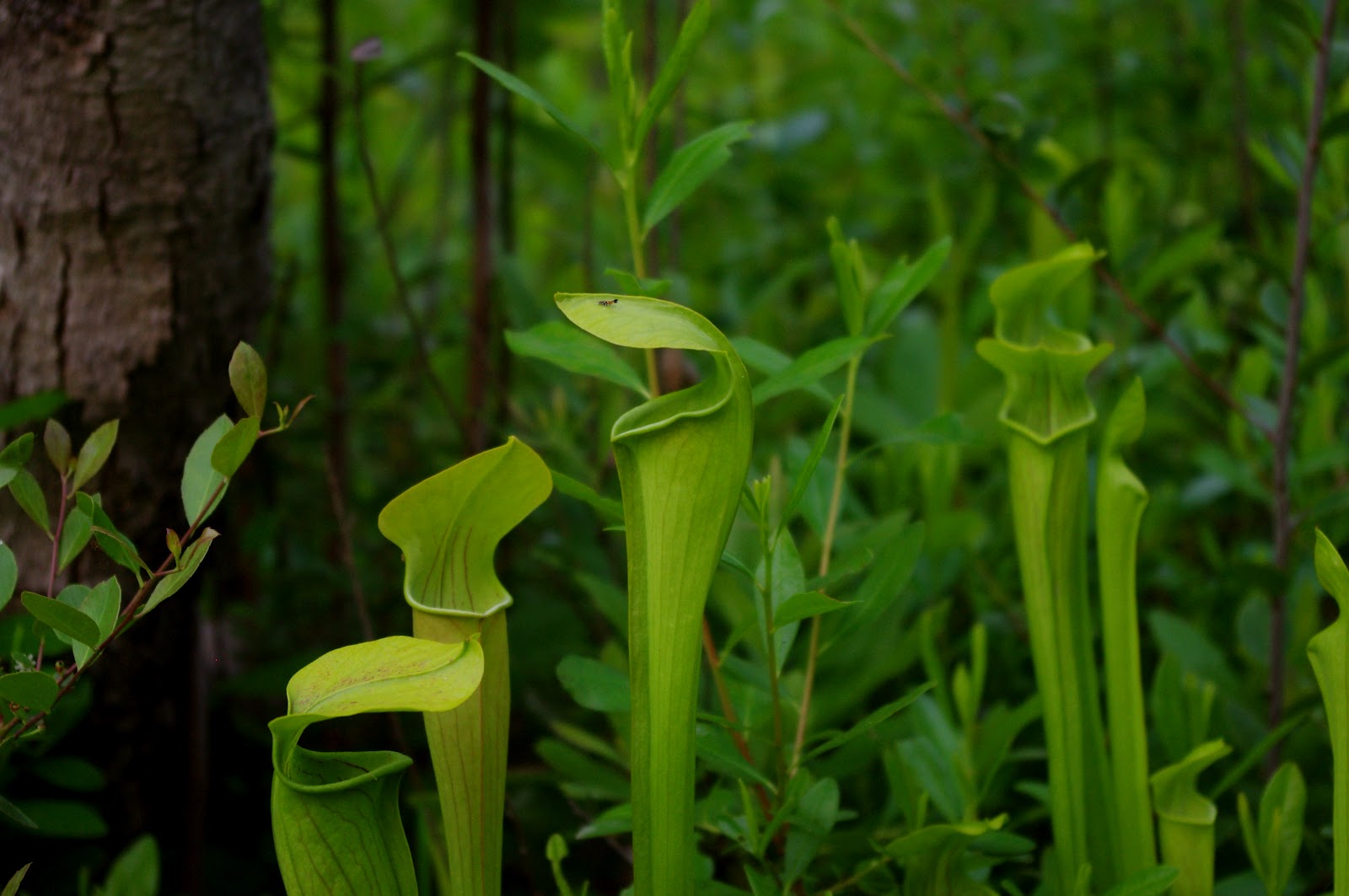
Sarracenia alata - Big Thicket National Preserve

Last summer I posted about how the severe drought in Texas was effecting the Sarracenia alata populations  in Big Thicket.  See:  Sarracenia alata 2011 Drought  Many plants in the Big Thicket area were severely damaged or killed due to the drought and populations of certain species declined considerably.

On my trip yesterday things looked much better than last year thanks to the good amount of rain we've had this spring.  It was much more lush overall with many species of wildflowers blooming.  The Sarracenia populations had many new leaves but I only saw one flower overall.

Sundew Trail:
The Sundew Trail Sarracenia population seems to have been hit hard by last years drought.
There were no flowers and all of the pitchers were thin, short, and phyllodia like.

A patch of some of the healthier plants along the Sundew Trail.  If I didn't know they were growing here I probably wouldn't have seen them.

Pitcher Plant Trail:
The Pitcher Plant Trail S. alata population looked really good.
There was a lot of healthy pitchers!


A nice big and healthy pitcher.  

The only S. alata flower I could find.

...So as you can see the Big Thicket populations of Sarracenia alata was negatively impacted by the drought last year but thankfully still survives.  Remember: when visiting it is important to never take anything!  No collecting leaves, plants, seeds, flowers, etc.  By collecting you could be removing plants that could determine the survival of the species.  As seen above - these two populations will have almost no seeds produced this year.  Hopefully there will be no more droughts in the near future and these Sarracenia alata populations can restore themselves to their previous abundance.

Sunday, October 30, 2011

Carnivorous Plants - Bradenton, FL

Whenever I come to visit my parents in Florida I walk along the equestrian trails in search for wildflowers. This day I was looking for carnivorous plants such as Butterworts - Pinguicula pumila, Sundew - Drosera brevifolia, and various Bladderworts - Utricularia species. There was a lot of wildflowers blooming during this visit and I was lucky to find lots of Bladderwort blooms!

Utricularia subulata - the most common bladderwort species around the neighborhood and along the trails. It is tiny! The stems are almost invisible and the flowers are smaller than pea.

Utricularia simulans - this was my first time seeing this species. It has a larger flower and has a bit more orange color in the flowers than U. subulata. It also had a fimbriate sepal which is quite pretty.

Sundew - Drosera brevifolia, this is another common species around the neighborhood. They are only about the size of a nickel. Drosera capillaris is also found here and grow around the same size. They can be distinguished by the flower stems - D. brevifolia is glandular (has the sticky droplets) and D. capillaris is smooth.

I also found a big surprise...

A Pine Lily - Lilium catesbaei!!


I found three of these lilies blooming when the trail started to become wooded with Oaks.

Thursday, July 14, 2011

Sarrcenia alata and the Drought

As you know this year and for the past few years much of the south has been in a drought. Many parts of the south are in an extreme or exceptional drought condition. These areas are home to many many unique plants and animals many of which are endemic to the south eastern United States. One group of these unique species is the Pitcher Plants of the genus Sarracenia. The pitcher plants are a remarkable carnivorous plant which lives in poor sandy acidic soils of the south east and have extraordinary colorful pitcher shaped leaves. All but one specie in the genus live on the coastal plane from Virginia south to Florida and west to east Texas. All of these species have become extremely rare and some critically endangered.
US Drought map for today showing much of the south covered in extreme and exceptional drought. Much of this area is Sarracenia habitat.

I wondered what effect the drought had on the local Sarracenia alata population in Big Thicket National Preserve. Usually the pitcher plants there are always healthy and colorful with pitchers lasting until winter. So we went to the Pticher Plant Trail to pay them a visit.

The effects of the drought were very clear. The Sarracenia alata pitchers were all dry and dead only being green a few inches above the rhizome. Many of the seed pods that were maturing seemed to be dead and dry before the seeds were ready. It was sad...

Here is pitcher that still has a little life surrounded with dead pitchers. There was also a lot of healthy Prairie Blazingstar - Liatris pycnostachya, a late summer/fall blooming wildflower that are more tolerant of dry soil.

I found a few whole pitchers. These were all small, less than 8 inches tall.

There was no sight of any other carnivorous plants that we usually see here such as: Drosera, Pinguicula, and Utricularia. The patches of Sphagnum moss were completely brown and dry. The sandy soil was also bone dry.

Dried up Sphagnum moss

After the pitcher plant trail we went to the Sundew Trail to see how the smaller population of Sarracenia alata was doing over there and hopefully photograph some Blazingstar - Liatris but the Sundew trail was worse than the Pitcher Plant trail.

These plants have endured droughts many times before this and it is part of the natural cycle but one can only wonder how long the drought can last and why is it so severe? Hopefully the rain will come soon and restore this area back to its former beauty.

Just to leave on a bright note: here is one of the few plants that were flowering.

Vernonia texana - Texas Ironweed


Tuesday, May 10, 2011

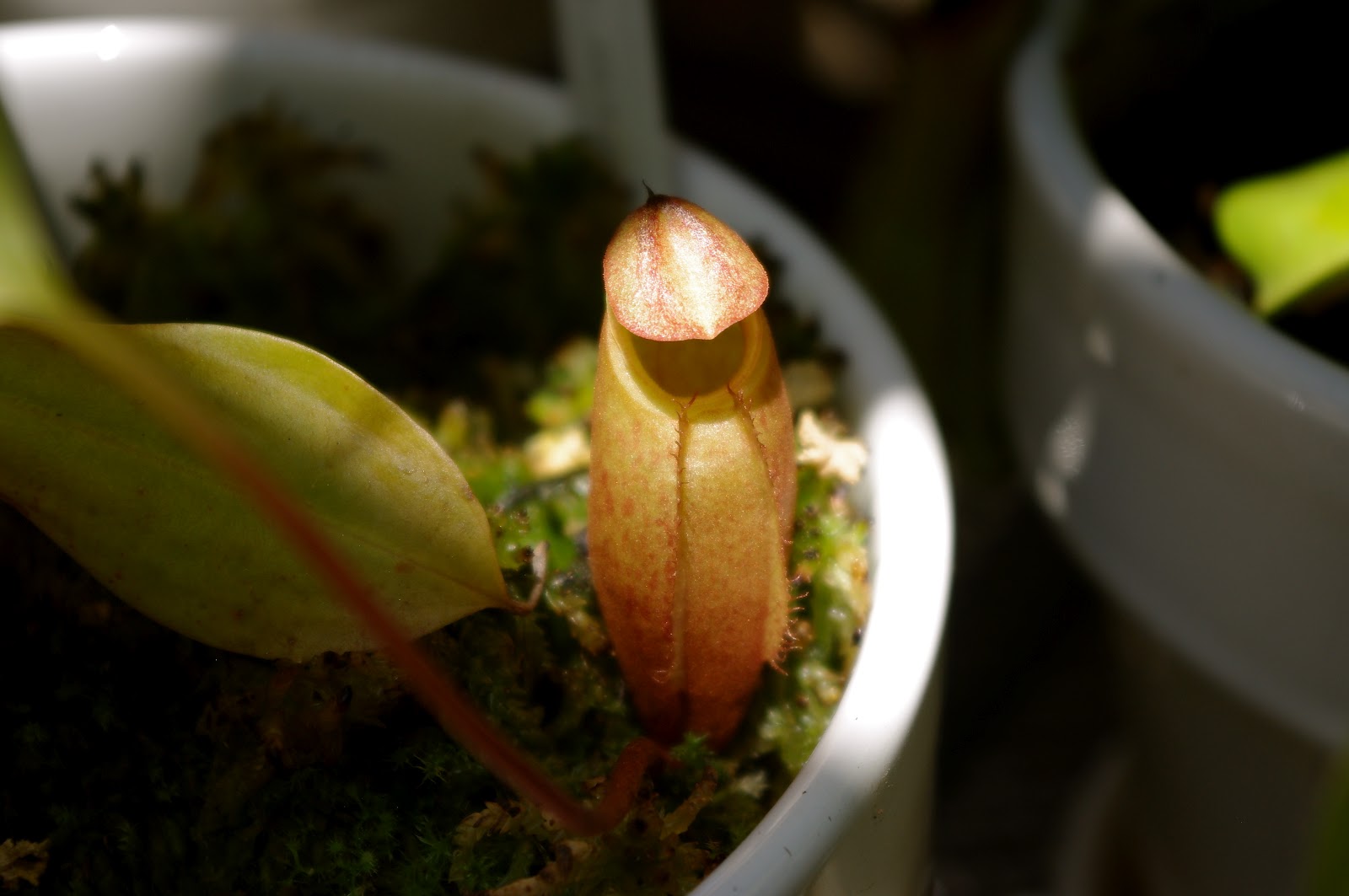
Nepenthes copelandii

Its such an nice spring day today! I have been gardening for most of the day but I wanted to come in and get a drink and share this picture with you. Its my Nepenthes copelandii. I bought this plant from Sarracenia Northwest about 2 years ago and it is doing very nicely on my bathroom window. The pitchers are as long as the plant is tall, which I think really looks cool. Care wise I don't do anything to it but give it water (lately Figi water that I haven't finished drinking) but also distilled water. I love the color of the pitchers... really beautiful.

Friday, July 24, 2009

Pinguicula gigantea x moctezumae blooming

Hi! Just wanted to post some pics of my Pinguicula gigantea x moctezumae that is blooming now. I was surprised how long the spur and scape is.

Saturday, June 20, 2009

Pinguicula moranensis

My Pinguicula moranensis a.k.a. a Butterwort is blooming! This specimen was bought from California Carnivores and has a nice bright flower. Pinguicula moranensis and other Central American Pinguicula are very easy to grow. This group of carnivorous plants is definitely one that you should try if you cant keep your beloved Venus Flytrap, Dionaea muscipula alive! Its great for a sunny windowsill and you can even go without watering for quite a while... well, I should say when it is dormant. :D